
Meet Doug Walrath
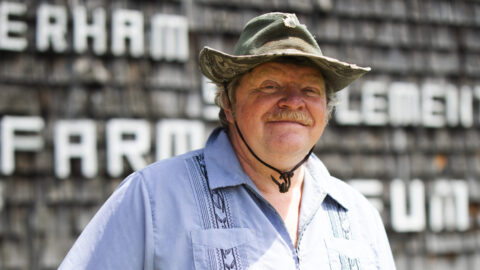
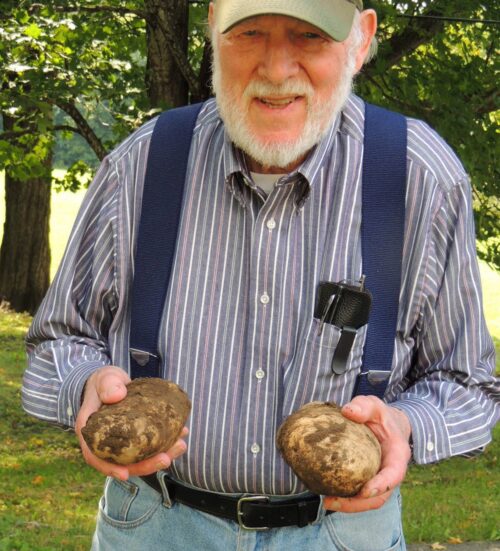
For more than forty years, Doug and Sherry Walrath have tended an old farmhouse and its surrounding woods along the Sandy River in Strong, a place their family simply calls Walrath Woods. On this land, stories of neighbors, animals, and grandchildren have woven together into a living legacy of stewardship.
Now, as Doug works with the Alliance to protect these 120 acres as Walrath Woods, including reopening the trail Sherry loved as the Sherry Walrath Memorial Trail, he is thinking less about what the land is worth on the market and more about what it can mean to the children, neighbors, and strangers who will walk these trails long after he is gone.
Rooted in Wonder
“I’m curious, and I’ve been that way since I was a little kid. I always wanted to know why things happened, how things work. I’ve always been a researcher, even when I wasn’t a formal researcher.” That curiosity carried Doug from the west side of Chicago to summers on his grandparents’ land in Iowa, where “they had land, and they worked it. And I worked the land with them. It may seem silly, but those two weeks every year connected the city kid to the land.”
Years later, he met Sherry, who “grew up on a farm in Michigan… She developed that kind of connection to the land right off the bat. When we got together in midlife… we were both starting over. And we were living in the inner city. And we said, we’d like to live rural.” Sherry could freelance as an interpreter, and Doug, by then an independent strategic planning consultant, could live anywhere and fly to his work.
“We looked around New York State. We couldn’t afford anything. One day, she saw an ad in Yankee Magazine for this farm. Sherry said, ‘Let’s go to Maine and look at that farm.’ You talk about fortuitous. We’re sitting on the deck in downtown Albany, reading Yankee Magazine. We drove up here.”
The realtor, Charlie Kamm, picked them up at their motel. “As we drove in the driveway. Sherry looked out the front windshield and said, ‘This is it. I want it.’ Charlie said, ‘You want it? You haven’t even been inside the house.’ And Sherry said, ‘ That doesn’t matter.’ She took her hands and spread them out towards the land. ‘This you can’t change, but whatever there is to change in the house, I can do that.’
“That was the instant connection. It took nearly a year and a lot of trust to make it possible. Julie Fast, who owned the property, needed money. But she and Sherry hit it off sitting at a picnic table out back here. Julie had another buyer who had offered her cash for the farm. ‘But I want you to have it. I will work hard with you to make that possible.’ She worked with us for 10 months so we could buy the farm. That’s Maine.”

"This Is My River"
Walrath’s farmhouse, built in 1843, sits above the Sandy River, with a path leading through the fields to the water. “Sherry used to walk from here across that little bit of field beyond the barn. And then there’s a path that goes into the woods. If you go to the left, you go right down to the river, where it’s shallow, which is where we used to take the grandchildren when they were young, and they’d go wading. If you go straight, there’s a big shale outcropping and a swimming hole. You can jump off the shale rock into the river.
“It’s a beautiful shale rock bank. Somebody carved their initials in it and a date. I think it’s 1858. The house is 1843, so that’s quite feasible. Sherry loved that trail and that rock.” Looking wistful Doug says, “Sherry said she would never leave here. She won’t because when we came back from the celebration of her life last summer, the family and I scattered her ashes in the field. She’ll always be in the field.”
Their grandchildren grew up swimming and fishing off that shale rock. “My son Stephen is a great trout fisherman. He caught a 21-inch trout off that rock. That’s a lot of fish. He was shaking when he brought it back to the house. When he was fishing another day, a little girl from across the river joined him on the rock. She said, ‘This is my river, you know… In fact, this is my rock… but you can sit on my rock if you want to… and you can swim in my river if you want to.’
“For a kid to be able to say to a neighbor, ‘This is my river, but you can swim in it if you want to.’ For a kid to have that kind of feel for the land is wonderful.” For Doug, that kind of easy belonging is exactly why this place matters.
📸 Image courtesy of Eisenhaur Photography.

Wild Neighbors
Life at the Walrath Woods has always included animals. One winter, a young porcupine started showing up. “We would feed the porcupine every day. She was pretty undernourished. The porcupine would come around every morning for treats. And then one day in the spring, it left, which is what you want it to do. You can help animals, but if they are wild, they need to go back to the wild. It was the same with the fox kits Sherry used to feed out the front door. She fed them until they grew up. One day, they were gone. It’s nature.”
Doug remembers the day he found a skunk in trouble. “I looked out by the sap house, and there was a skunk stuck in some barbed wire that someone had left out there from many years ago. I thought, ‘I have to help that skunk out. That’s terrible to be stuck in that barbed wire, because he’ll just die there.’” He fetched a pike pole from the barn and stood a few feet away from the skunk. “The skunk looked at me, and I looked at him, and I said, ‘Now, Mr. Skunk, you have a problem. And I’m going to help you with your problem. But I don’t want you spraying that smelly stuff on me.’
“I hooked the hook on the end of the pike pole on the barbed wire, and I pulled that barbed wire out of that skunk’s fur all the way around him until he got free of it. It makes me teary to think about. When he was completely free, he looked at me, and in his own way, he didn’t say it, but he said thanks, and walked away. He didn’t spray me.”
Becoming Conservationists
Stories like that sit alongside the everyday work of caring for the land. “Rupert Pratt is the one who cuts the hay on my field. Rupert is a good steward of the land. He has taken care of that field for 25 years. He’s enriched that soil… the topsoil alone on that field is 16 inches deep… And so that land is as rich as it was 25 years ago when he started because of the way he’s nurtured the land.”
Doug has never posted his land. “I figure that I’m fortunate, I’m gifted to be able to have this land, and so my neighbors have always been able to use it. I got to know my neighbors because I didn’t post my land, and they could hunt on it.” When he discovered piles of dumped tires up the ridge, it was his neighbors and local clubs who cleaned them up. “They cleaned up those tires and loaded them on my big farm truck. I must have had 50 junk tires piled in that truck. When I got to the transfer station in Farmington, the attendant said, ‘Where’d you get all these tires?’ I told him the story, and he looked at me, and said, ‘Take them all, and throw them in that bin, and have a nice day.’”
Doug’s connection to High Peaks Alliance grew out of another long Maine friendship. “I found High Peaks Alliance through Leila Percy. Leila Percy is a jazz singer that Sherry used to interpret for. For many years, Leila was the representative from Popham in the legislature. She chaired the committee that deals with wildlife in the assembly. Through that committee, she met Brent.
Sherry and Doug started talking with Leila about how others might experience the woods and river they loved so much. “There’s no public walking trail in Strong. Sherry used to walk from here to Strong on an old trail that runs along the river.” Doug wants that kind of close-to-home river access to be more than a private privilege. He hopes that the same trail Sherry walked for decades will reopen as the Sherry Walrath Memorial Trail.

A Lasting Legacy
Over time, he came to see conservation as part of his life’s pattern. “I think that wherever we go through life, we leave a trail. And I would like to leave an open trail. I would like to have somebody say, when he got to the point where he couldn’t walk that land anymore like he used to, he wanted to leave a trail so that other people could be able to walk that land.”
Money, in the end, didn’t feel like the right measure. “I know I could sell our two miles of field and forest that runs along the Sandy River and probably get a big bunch of money for it. Who cares? What are you going to do with that when you’re 93? Now, even if it goes to someone who wants to use the farmhouse as a second home, they’re going to be surrounded by conserved land. That open land will send a message to them.”
Working with the Alliance, Doug found a partner who understood that message. “Brent is real. You know exactly what you’re going to get with him.” After they signed the conservation agreements at the bank, Brent turned and asked if he could buy Doug a coffee. “We went to Aroma Joe’s, and we had a cup of coffee. No fancy restaurant, just a local coffee spot where everybody knows him, and he knows everybody.”
Looking ahead, Doug imagines the land doing what it has always done: holding people, stories, and wild things to remember. “I’d like somebody else to be able to sit on that rock and have a little girl tell them that they can swim in ‘my river.’ I’d like to be able to know that somebody’s walking that trail Sherry loved.
“We only understand what it means to be human when we understand how we fit into the rest of the living world around us. When you’re connected with the land, you’re connected. Connected with the land means to me all the things that are part of the land, the vegetation, the river, the animals. I relate to all of it.”
A Legacy of Connection
As Walrath Woods moves toward permanent protection, Doug’s stories have already done what he hopes the land itself will do: invite people in, offer them a place to belong, and gently remind them that they are part of something larger than themselves.
From the skunk in the barbed wire to the little girl who shared “her” river, Walrath Woods reflects a way of living with land that is generous, attentive, and deeply rooted in community.
By choosing conservation, Doug leaves us this wild place and the Sherry Walrath Memorial Trail, a trail that begins at an old farmhouse in Strong and continues along the Sandy River, where future generations will wade, fish, wander, and quietly say, this is my place too.
What legacy will you leave? Contact Brent to explore conservation options and ensure your corner of the High Peaks endures.