Meet Carson Hinkley
If you follow Wildlife Watch with Carson, you know that Carson Hinkley pays attention. He notices which birds have returned to Perham Stream, how many are gathering outside his window, and what is changing as one season gives way to the next.
If you’ve met him at the Perham Stream Birding Trail, you may also know how much a conversation with Carson can add to a walk. A curve of rocks becomes the site of a school. An open field becomes part of a family’s working farm. There is usually more to see than you first realized.
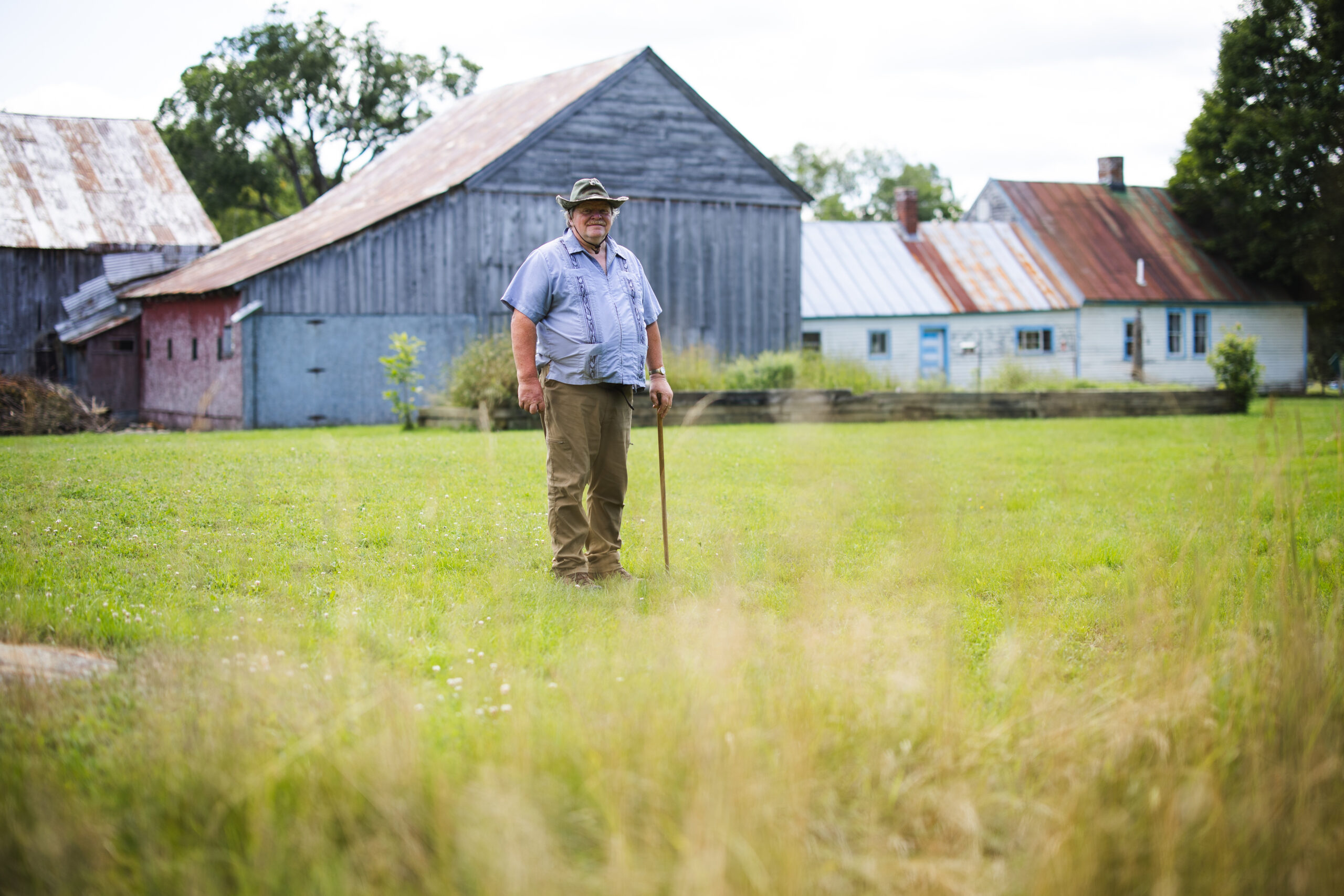
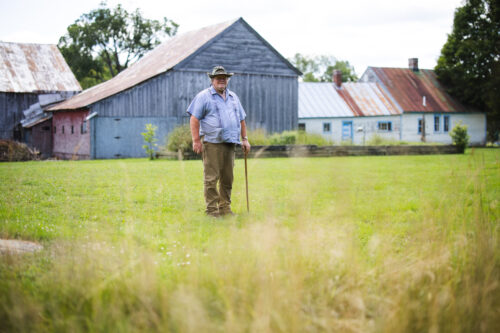
Carson has lived in the farmhouse across from the trail his whole life. A seventh-generation resident of East Madrid, he has spent much of that life caring for the land his family knew before him and helping other people get to know it, too.
For this month’s Voices of the High Peaks, we talked with Carson about growing up at Perham Stream, opening the trails to visitors, and what he hopes people will find here long after him.
The Animals Came First
Growing up, Carson’s day began with the cows.
His family milked by hand, and he handled the morning milking because he could calm the animals, patting them down until they settled. When he and his brother were boys, their father gave each of them a newborn calf to raise. Feeding, cleaning, and bedding them came before sitting down to their own meal. “You always fed them before you got fed yourself,” he says.
That responsibility stayed with him long after the farm animals were gone.
On Stewardship
Asked what stewardship means to him today, Carson talks about the birds and other wildlife around his home in much the same way.
“It means tradition of carrying down seven generations of livelihood,” he says. His family had a guiding philosophy: “Live with the land, not against the land.”
For Carson, that began with daily chores. Today, it includes watching for young rabbits when he mows, noticing which berries are ripening along the trails, and paying attention to the animals that share the property.
His interest in birds began early, too. Around age seven, he looked out from his upstairs bedroom and saw a large bird perched on a glacial rock. He went downstairs to ask his parents what it was. Together, they looked it up and identified it as a golden eagle.
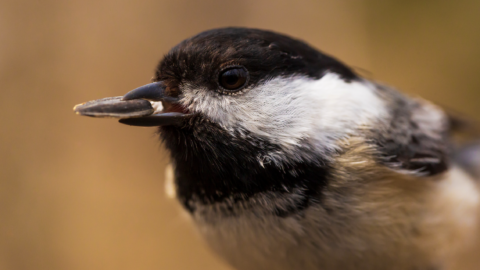
Other birds became familiar through their routines: swallows around the barn, chickadees close to home, and kingfishers chattering along the stream. A female merganser used to land on the kitchen chimney in the morning and announce herself. “That was my rooster,” he says.
The kingfisher remains a favorite. But Carson doesn’t describe watching birds as a search for the next species or a longer list. “I just go and enjoy them,” he offered.
That enjoyment comes through in his monthly wildlife updates and in the sightings he remembers: a maple tree crowded with migrating blackbirds, or a flock of 47 ducks passing overhead, the largest he had counted.
A Trail Already There
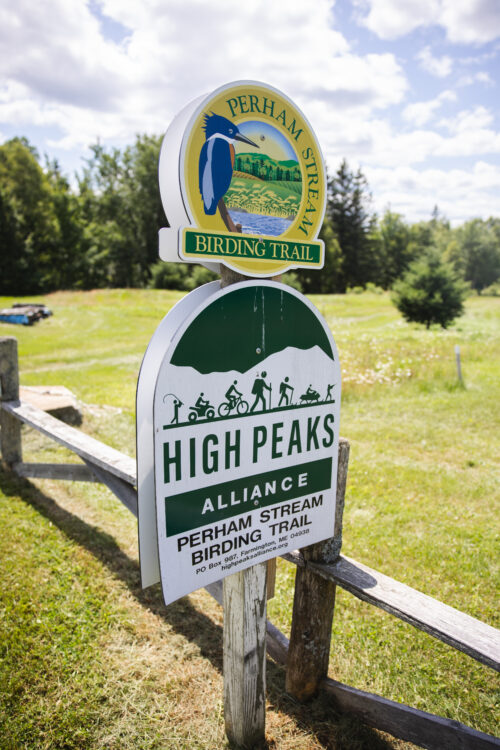
Long before there was a public birding trail, Carson’s family welcomed people onto the property. Neighbors rode horses, visitors walked the land, and occasionally a lost Appalachian Trail hiker found the way down.
When Lloyd Griscom and Kirsten Kelly were looking for an alternative to a nearby birding trail that was being lost, Carson suggested they look across the road to his property.
The routes were already there: old family roads connecting fields, thickets, wet ground, woods, and the stream. Carson took them out to see it. Then they reached the fields and the mountain views.
“Are you sure we can do it?” he remembers them asking. Carson’s answer came with a commitment. “If you use my property, I’m going to take care of it.”
He began maintaining and mowing the trails, work he has continued as he is able. While mowing, he watches the trail edges for insects and young animals, checks on the wild strawberries, blueberries, raspberries, and blackberries, and keeps an eye out for wildlife.
More Than Birding
The name “birding trail” has never quite covered everything he wants visitors to find. “I always considered it a nature trail because you see a lot more than just birds,” he says.
There are the plants and insects, the sound of Perham Stream, and the views across the fields. There is also the history, though visitors sometimes need a little help knowing where to look.
More Than a Walk
One woman returned from the trail because she hadn’t found the old school site. Carson asked whether she had noticed the small curve of rocks along the way. She had. That was where the school stood.
It is the kind of detail Carson likes to share before people head out. A short conversation helps him learn what interests them history, wildlife, or scenery and gives them something to look for along the way.
Some return with questions. Others want to see his photographs of the post office and old farm buildings. What first looked like woods and fields begins to take shape as a settlement where people lived and worked.
Carson enjoys those conversations, and he notices when people come back. He tells of one woman who moved nearby and began visiting with her three dogs. She brought her mother, too. Afterward, he learned that her mother kept asking to return.
The dogs became familiar visitors as well, running over to greet him when they arrived. On one visit, a dog was so reluctant to leave that it didn’t want to get back in the vehicle.
For Carson, welcoming people has become another part of caring for the place. He likes to hear what they are interested in, tell them what they might find, and see what brings them back.
Keeping the Knowledge With the Land
As caring for the property became harder, Carson wanted to know that the land would stay protected without losing his connection to it. He still wanted to use and care for the place that had supported his family for generations.
Conversations with Lloyd Griscom and Brent West helped him find a path forward with High Peaks Alliance. In 2022, it was conserved for the community to enjoy forever.
But when Carson talks about the future, he thinks beyond the land itself. He thinks about the plants and animals that need ongoing care. He also thinks about the village, the family machinery in his museum, and who will know the stories behind them.
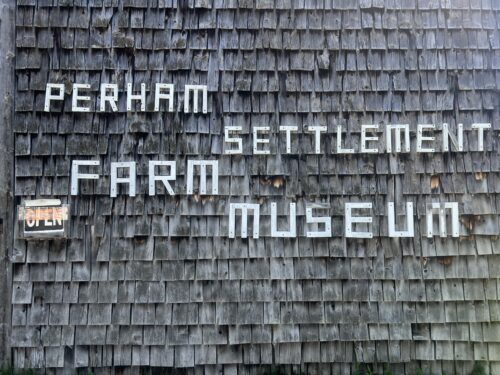
The equipment survived because earlier generations put it inside the barns rather than leaving it outdoors. They expected a machine to last, Carson explains, and took care of it accordingly.
He arranged the museum to follow the farming year, from preparing and planting the ground through mowing and raking. Visitors can follow the work through the seasons rather than encounter a room full of unrelated tools.
Carson would like younger people to learn how that machinery operates while he can still show them. He used it himself, and he wants that practical knowledge to survive alongside the equipment.
His oral histories preserve another part of that knowledge: the names, places, and memories that help explain the landscape. Like his conversations at the trailhead, they offer a way to understand what was here before and what remains.
A Small Branch Helps
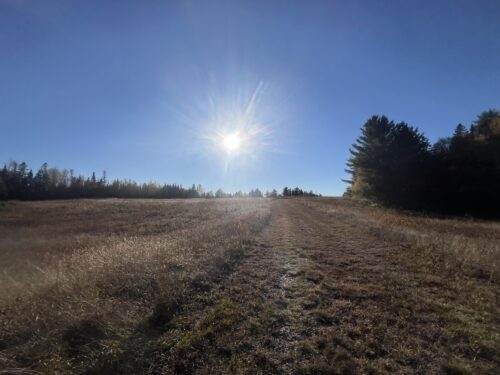
When Carson looks across the road, he can picture sheep coming out of the barn his great-grandfather once used. In the fields, he imagines his great-grandfather moving the flock with his dogs. He is careful to distinguish those pictures from his own memories. He never saw the sheep coming out of that barn. But he knows enough of the family’s history to imagine the scene.
He knows future visitors will not see the landscape quite as he does. Still, he hopes they will be able to understand something of the lives lived here. “I hope they find it just about the way it is and being able to see that there was a village here, a settlement, a livelihood.”
That is what Carson shares through his stories, his museum, and the conversations that begin before a walk: a way to see more of Perham Stream than the trail alone can show.
And for anyone wondering how to help care for it, he has a simple place to start.
“If they see a small branch, move it. It helps.”