
Meet Eugenie Francine
Eugenie Francine’s life reads like a map of the landscapes that shaped her: the woods of northern Quebec, the forests of Maine, the old camps, the rivers, the historic places, and the communities built around them. She speaks about all of it with the clarity of someone who has spent a lifetime paying attention, and with the warmth of someone who knows that place is never just scenery. It is memory, labor, responsibility, and belonging.
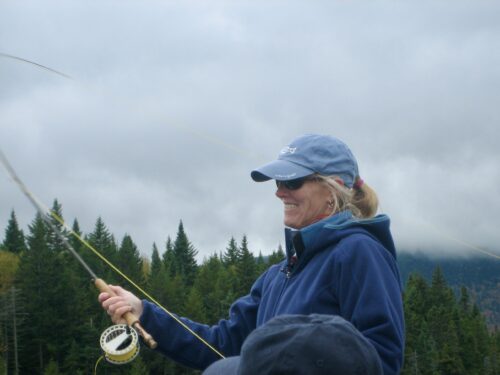
A Childhood in the Woods
“I grew up in the Canadian north woods, just running wild,” Eugenie says. “We had no running water and no electricity, no nothing, but it was a wonderful way to grow up.” That childhood was not defined by comfort, but by freedom and immersion. The camp her family ran in northern Quebec gave her a hands-on education in the natural world long before “outdoor recreation” became a phrase. Summers were spent getting to camp by canoe, chinking log cabins, hauling water, and living in close relationship with the land. “My parents built that camp log by log,” she remembers. “And that encampment was there for years until it wasn’t.”
That last part matters. Eugenie’s understanding of landscape is shaped not just by what exists, but by what disappears. She grew up seeing how forests can be cut, rivers degraded, and histories erased. The older she got, the more she recognized that land use is never neutral. “We could see the destruction of the land,” she says of the logging country she knew as a child. “The lumber companies were pillaging as fast as they could deliver their loads,” and in those years there were no rules or regulations in the Canadian woods. The industry was looking at the foreground, not the whole picture, and it did not understand the ramifications then or what they would become. Hindsight is 20-20.
Where It All Came Together
At the same time, she says Maine’s paper company lands offer something rare: free access to large stretches of land and the chance to continue traditional recreation. “I do feel that we are very fortunate here in Maine that the paper company allows free access to most of their lands and allows for traditional recreational activities. The alternatives are vast tracts under private ownership that are posted.” That awareness gave her a conservation ethic that is both emotional and practical: land must be cared for, because once it is lost, it may not come back.
When she came to Maine in 1976, after her parents retired and she graduated high school, the move felt natural. “Moving to Maine wasn’t a culture shock,” she says, because wild places were already familiar. But over time, Maine became more than familiar. It became home in a deeper sense; a place where her love of history, ecology, and public land all came together. “I’ve been here 50 years now,” she says, and that span is not just a measure of time. It is a measure of belonging.
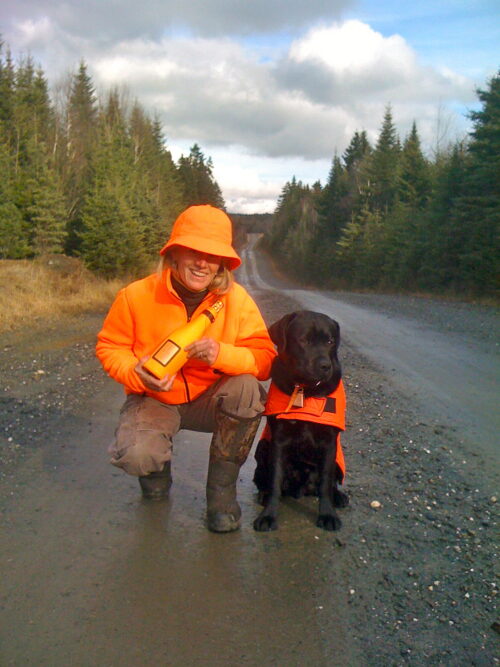
Reading the Landscape
One of the most compelling parts of Eugenie’s story is how naturally curiosity turned into expertise. Her path into environmental work began, as many important things do, with a question. While walking in the woods with her dog Jack, she heard what sounded like ducks calling deep in the forest. “I’m like, what would ducks be doing in the middle of the woods?” she recalls. That question led her to discover vernal pools and wood frogs, and then to a whole field of work she had never planned on entering. “So, then I went back into work, and I grabbed all the information I could on the Vernal Pools,” she says. “And learned about Vernal Pools.
That journey is a reminder that conservation often starts with attention. You notice a sound, a pattern, a place that doesn’t fit the expected map, and then you keep looking. Eugenie did exactly that. She became fascinated by the hidden life of vernal pools; those temporary, easily overlooked wetlands that are crucial breeding grounds for amphibians and part of a much larger forest ecology. “There’s a whole ecosystem in these pools that’s linked with everything in the forest,” she explains. For her, the magic was not just scientific. It was moral. These places mattered even when most people thought they were “nothing more than a puddle.”
That phrase captures one of the central tensions in her career. Vernal pools are ecologically important, but they are small enough to be dismissed, drained, or filled without much public outcry. Eugenie remembers the arguments that came with trying to protect them. Developers wanted to minimize the pools; land protection advocates had to explain that the pool itself was only part of the story. The surrounding woods matter too, because amphibians use the forest around the pool for most of their lives. “It’s a matter of education,” she says. “It’s learning and educating.”
Her love of birds, animals, and the workings of the woods extends beyond policy or consulting work. It is the kind of curiosity that makes a walk into an adventure. She talks about using her phone not for distraction, but for discovery: identifying birds, plants, and mushrooms, learning in the moment, letting the landscape reveal itself one species at a time. That delight in noticing is part of why she has remained so engaged with the outdoors.
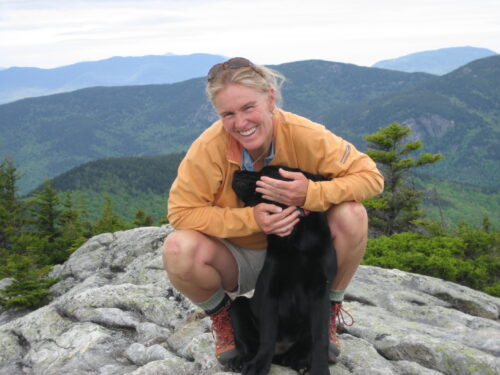
The Thread of History
History is the other great thread running through Eugenie’s life. She speaks about ancestry, objects, and place with the conviction that identity depends on continuity. “It all had a provenance. It had a story, a history,” she says of the things she grew up around. That reverence for the past was not ornamental. It was foundational. She was raised to understand that history matters because it explains how people got here and what values they carry forward. “Without that, we have no identity,” she says. In the High Peaks, where old camps, logging routes, guide traditions, and conservation stories overlap, that sensibility feels especially important.
When she and her husband purchased their camp in Oquossoc, Eugenie says, the connection to the area’s history and heritage was cemented. At the Rangeley Lakes Historical Society (now Historic Rangeley), she found herself in a landscape where natural history and human history were inseparable. “I was just mesmerized because this area is so rich in history and heritage,” she says. That richness shows up everywhere to her: in old cabins moved across lakes, in camp architecture, in the stories tied to lakes and islands, and in the layered memory of who has used and cared for the land over time. For Eugenie, being in a cabin built in the late 1800s is not just charming. It is a reminder that she is part of a long line of people who lived with the woods and waters before her.
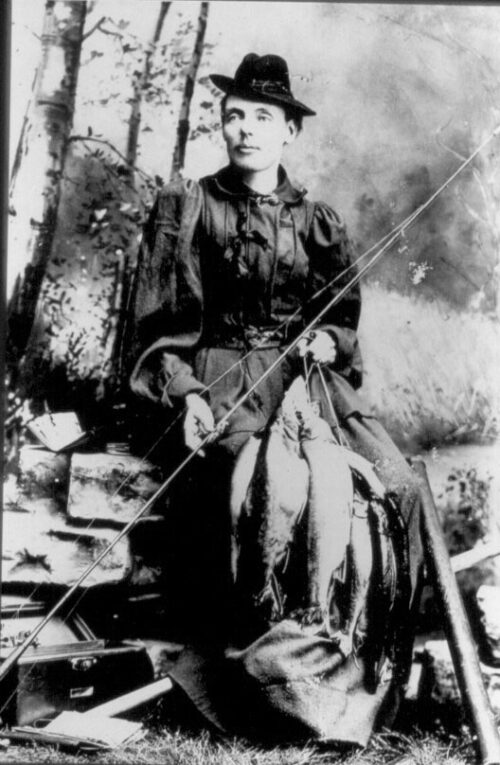
Friends of Fly Rod
That belief is important to Eugenie, too. It is part of why she sees outdoor access as more than recreation. It is health, identity, and civic belonging. Fly Rod Crosby’s advocacy for Maine guides, fish and wildlife, and outdoor education helped define a model of stewardship that still resonates. Eugenie understands that legacy not as a museum piece, but as a living tradition; one that should be visible, celebrated, and passed on.
That is why she is leading the Friends of Fly Rod, a group who has commissioned artist Erin McCarthy to create a life-sized bronze statue of Fly Rod that will be installed in front of the new Maine Department of Inland Fisheries and Wildlife in Augusta. Fly Rod will welcome thousands of visitors and represent Maine’s rich outdoor sporting history and heritage. The project is halfway through its fundraising campaign.
Fly Rod was a trailblazer, an outdoorswoman, a syndicated journalist, and a conservationist. She dearly loved her state of Maine and worked tirelessly to encourage everyone, especially women, to get outside and enjoy nature. “For me, having Fly Rod front and center at the headquarters… is like a blessing,” she says. “Nature is where I find my solace and serenity, and knowing that Fly Rod will be forever present to continue that inspiration for generations to come is like the culmination of my life’s work.” The finished space will do more than commemorate one remarkable woman; it will help preserve a wider story about stewardship, access, and the enduring value of public connection to the land.
Keeping the Land Cared For
Even her stories of family, place, and daily life are threaded with that sense of accountability. She talks about cameras at gates, vandalism, trespassing, and the tension between privacy and protection. She laughs, but the concern is real. Fences, she says, “try to come in,” and landowners often have to take measures they never wanted to need. That perspective adds another layer to her conservation ethic: stewardship is not romantic. It includes conflict, vigilance, and the practical work of keeping spaces cared for.
At the center of it all is a person who still finds joy in small miracles. A frog call in the woods. A woodcock in a cemetery. A warbler flashing in a bush. A loon count on a foggy morning when the whole lake seems to appear out of nowhere. These moments matter because they are where her attention lands. They are what keep her connected to the land she has spent a lifetime loving.
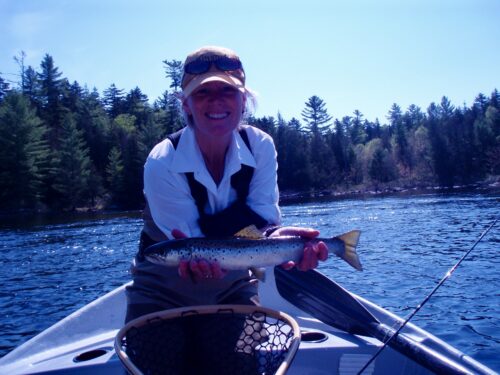
Thank You, Eugenie
Eugenie’s story is about the power of paying attention across a lifetime. She has noticed the land when others overlooked it, listened for life in the woods when others heard only noise, and traced the links between history, ecology, and identity with uncommon care. That is what gives her voice its strength. She understands that the High Peaks is not just a place to visit. It is a place to know, protect, and remember.
Thank you, Eugenie, for sharing your story and for the many ways you help keep the High Peaks alive in memory, in practice, and in spirit.
Learn more about Fly Rod and the Friends of Fly Rod Crosby by visiting their website. Explore the landscape Fly Rod lived, worked, and played on via the Fly Rod Crosby Trail. Watch Maine Public’s Borealis episode featuring both the Friends of Fly Rod and the Alliance’s Trail.